There are three types of Asian noodles: glass, wheat and rice. Many subcategories have their preparation methods, ingredients and shapes. Navigating the Asian noodles aisle is difficult if you reduce this diverse cuisine to just three categories. This guide will help you find the right Asian noodle for your needs. It breaks down texture and flavour to show you the best choices.
Different types of noodles with pictures
Check out our top ten noodles, complete with photos so that you can easily identify them when shopping. Noodles are a common staple in Asia, with China having the highest number of noodles made from local ingredients. We explore Asian noodles from different cuisines, including Thailand, Singapore, Korea, and Japan.
Ramen Noodles
Ramen soup is a rich, brothy recipe full of proteins, vegetables and spices. Ramen noodles are made from wheat flour, salt and water. Kansui is a type of mineral water that may contain phosphoric acids and sodium carbonate.
- Ramen noodles ingredients – wheat flour, salt, water, and Kansui
- Ramen Noodle Flavor Ramen noodles are mild in flavour and can be used with any broth.
- Ramen Noodle Texture Ramen noodles can be firm but not too crunchy.
- Ramen Noodle Shape Ramen noodles are available in various shapes, including straight or curvy, depending on the application.
- Types Of Ramen Soup There are four types: shio (salty-based ramen), Shoyu (soy sauce ramen), miso (soybean paste-flavoured ramen) and Tonkotsu (pork bones broth ramen).
Udon Noodles
Udon, a Japanese wheat-based noodle with little flavour, is dense and chewy. Many regional variations vary in thickness, smoothness, width, and other characteristics. No matter what region it is from, udon always has the same white colour. Udon noodles can be purchased fresh or dried depending on your needs. Udon noodles dried in the oven are often similar to fettuccine in size and shape. Udon noodles made from fresh ingredients are often rounder and plumper.
- Udon noodle Ingredients – Flour, Water
- Udon Flavor – Udon lends itself to spicy sauces and broths.
- Udon Noodle Texture Udon noodles can be chewy or soft.
- Udon Noodle Shape Udon noodles are long and thick. Fresh udon tends to be round, while dried udon can be flat.
- Udon Noodles Types – Hoto Sanuki Udon Inaniwa Udon Kishimen, Ise Udon
Lo Mein vs Udon
Lo mein is made with egg noodles, while udon uses wheat noodles. This is the biggest difference between lo mein & udon. Udon noodles are usually wider than lo mein egg noodles. Lo mein noodles are chewier than udon because they contain eggs. They also hold up better to pasta dishes. Udon noodles made from plain wheat absorb the broth and are great for soups.
Rice Noodles
Asian rice noodles can be loosely classified under the Cantonese fun and fen. Simple rice flour, water and water are the basis of most Asian rice noodles. Asian rice noodles come in many sizes and lengths, from 5 cm long silver needle noodles that are 5 mm wide to inch-wide chow fun portions of pasta. Rice noodles are the foundation of many popular dishes such as Singapore noodles, Pho and Pad Thai. Rice paper is made from the same recipe as Vietnamese summer rolls.
- Rice Noodle Ingredients, Rice Flour and Water
- Rice Noodle Flavor: Rice noodles easily absorb sauces, broths, and other flavours.
- Rice Noodle Texture- Rice noodles are springy, chewy and slippery.
- Rice Noodle Shape This is the most popular type of rice noodle. It’s flat and long.
- Types Of Rice Noodles – Rice Sticks. Kway Teow. Silver needle. Chow Fun. Chang Fun. Lai Fun.
Lo Mein vs Rice Noodles
Lo mein noodles are made from wheat flour, water, egg, and egg. Rice noodles are made from rice flour and water. Rice noodles are the best choice if you want a noodle that absorbs the flavours of your sauce or broth. Lo mein (or any other Chinese egg noodle) will provide a creamy, chewy noodle to make a great base for your pasta dishes.
Soba Noodles
Japanese noodles are made from buckwheat flour (soba) and water. To make the noodles more sturdy, many varieties include whole wheat flour. Pure buckwheat soup is ju–wari soba, and 80% buckwheat soup is Hachi–wari soba. You can find authentic soba noodles made with high-quality buckwheat flour by checking the labels.
- Soba noodles Ingredients – Buckwheat Flour and Water (sometimes)
- Soba Noodle Flavor- Soba noodles have a sweet, earthy taste.
- Soba Noodle Texture Soba noodles are chewy and have a grainy taste.
- Soba Noodle Shape Soba noodles come in multiple thicknesses. They come in a variety of shapes, including square or round.
- Soba Noodles Types – Ju–Wari Soba. Hachi-Wari Soba. Green Tea Soba. Ume Plum Soba.
Glass Noodles
Glass noodles are also known as cellophane noodles and bean thread noodles. They are thin, long noodles made of starch and water derived from beans or tubers. Glass noodles are made from tapioca starch and sweet potato starch, potato starch and tapioca starch. These noodles are gluten-free and can be used to substitute for pasta or wheat-based noodles. Before purchasing glass noodles for your Gluten-Free Menu, make sure you check the label.
- Glass noodles Ingredients – Vegetable starch, water (commonly sweet potato, mung bean or tapioca).
- Glass Noodle Flavor Most glass noodles have a mild taste and little sweetness.
- Glass Noodle Texture- Glass noodles are slightly chewy and gelatinous.
- Glass Noodle Shape Most glass noodles can be found long and thin.
- Types Of Glass Noodles – Sweet potato starch, Arrowroot starch, and Mung bean starch glasses noodles, tapioca, and Tapioca glass noodles
Chow-Mein Noodles
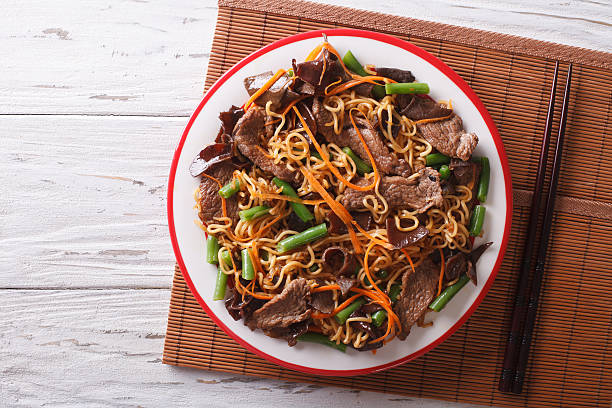
Mein refers to Chinese noodles. Chow, which means fried, is what mein stands for. Chow mein noodles are egg noodles that have been fried in oil on both sides. This gives them their nickname of “twice-browned noodles”. There are two types of chow-mein: crispy chow me and steamed. For steamed chow, mein chefs flash fry the egg noodles, then toss them with the rest and coat them in a light sauce. To make crispy chow mein, cooks flatten the noodles while deep-frying them.
- Chow Mein Noodle Recipes – Chow Mein noodles are egg noodles made of egg, water, or wheat flour.
- Chow Mein Noodle Taste – The mild flavour of the noodles is masked by the sauce used in Americanized chow mein. Chow mein sauce is a combination of sesame oil and oyster sauce. It has mildly sweet and savoury flavours.
- Chow Mein Noodle Texture Chow Mein noodles can be either stiff or crunchy, depending on how fried.
- Chow Mein Noodle Shape Chow mein noodles can be either flat or round.
- Chow Mein Noodles Types – Use fresh or dried egg noodles to make a soft chow mein, or use dried egg noodles to make a crisp chow mein.
Vermicelli Noodles
Vermicelli refers to a wide range of thin Asian noodles. Vermicelli is a noodle with fewer than 0.06 inches (1.5mm) diameter. Rice vermicelli is the most common type of Asian vermicelli noodles. Rice vermicelli noodles are also known as bee hoon in Hokkien Chinese and mai fun in Cantonese Chinese.
- Vermicelli noodles ingredients – There are various vermicelli types, including wheat, mung beans, potato starch and tapioca.
- Vermicelli Noodle Flavor Vermicelli noodles have a variety of flavours. Rice vermicelli is the most popular and absorbs all flavours.
- Vermicelli Noodle Shape – Vermicelli portions of pasta are round and extremely thin (diameter below 0.06 inches, aka 1.5mm) and can be up to 18 inches long.
- Vermicelli Noodles Types – Misua Pad Woon Sen Mai Fun Bun Kya Zan
Somen Noodles
Somen noodles are thin (less than 0.05 mm in diameter), light-coloured Japanese wheat noodles made with superfine wheat flour, salt and water. The noodles are coated with vegetable oil after being hand-stretched into thin strips to prevent drying out. Because of their thread-like consistency, you can cook some noodles in less than 3 minutes in boiling water. However, because they contain salt, it is best to not salt the water before boiling them. To remove any oil, rinse the noodles in cold water after cooking.
- Some noodle Ingredients – Flour, Salt and Water
- Somen noodle Flavor – Somen pasta has a mild flavour and should be served with a tangy condiment.
- Somen Noodle Texture Somen noodles are light and slippery.
- Somen Noodle Shape Somen noodles have a cylindrical shape with less than 0.05mm diameter.
- Types Of Somen Noodles – Miwa Somen Shimabara Somen Shima No Hikari Somen
Chinese Egg Noodles
Chinese egg noodles are also known as egg noodles. They are made of wheat flour and water. Egg noodles can be made into thick or thin strands. Chinese egg noodles are loved for their chewy texture and springy taste. They are a staple ingredient in traditional Chinese dishes like chow mein and wonton soup. Some shops use food colouring to colour their noodles, but this is not the norm.
- Chinese Eggnoodle Ingredients – Water, Wheat Flour, and Egg
- Chinese Eggnoodle Flavor – Egg noodles have a creamy texture but little flavour.
- Chinese Egg Noodle Texture Egg noodles are springy and chewy.
- Chinese Egg Noodle Shape The most popular Chinese egg noodles are long strands, either flat or thin, like spaghetti.
- Different Chinese Egg Noodles – Lo Mein, Lo Mein Thin Wonton Noodles and Wide Wonton Noodles
Kal-Guksoo Noodles
Kal-Guksoo, a Korean noodle, is made of wheat flour, water and eggs. They are different from Chinese egg noodles because of their method. Korean noodle manufacturers roll the Kal-guksoo dough to a thin rectangle, then cut it into ribbons using a knife. Kal-guksoo is an English translation of knife noodles. They are not strung or spun but cut. Some Kal-guksoo varieties include dried bean powder and mashed mung bean as thickening agents.